TL;DR: Jev is a genuinely useful, very fast decision component you can wire into an agent loop for routing, triage and gating — but it isn’t a coding model, it isn’t a new form of AI, and it isn’t “193x” anything by default. Learn the narrow job it does well, and let the rest of the noise go.
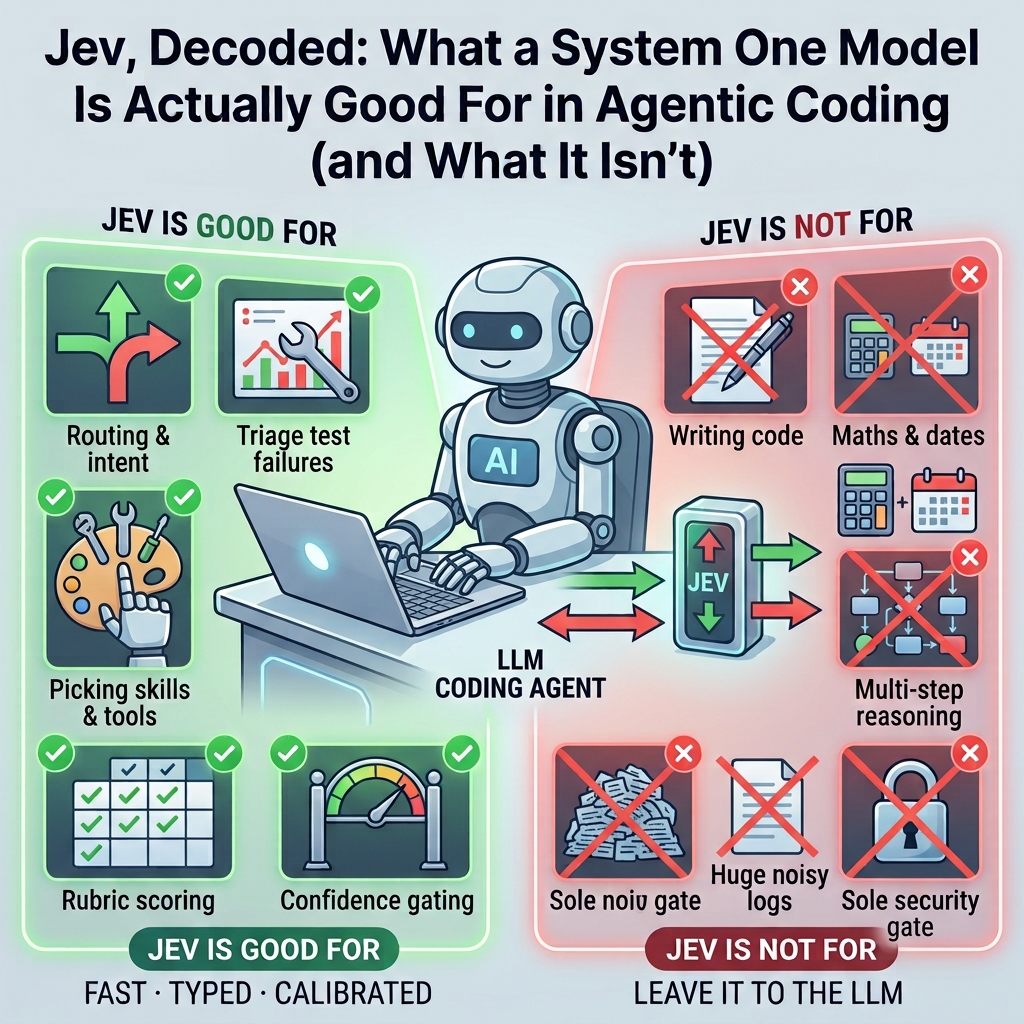
Generated AI image by Google Gemini Nano Banana
Introduction
If your LinkedIn or X feed looked anything like mine during September, Jev was everywhere. “Jev just killed LLMs.” “Swap your coding agent’s brain for Jev and save 400x.” Carousels, reels and threads — many from accounts that, as far as I could tell, had never made a single API call to it.
I’ve been writing a series on the disciplines forming around AI agents — context, harness, loop and graph engineering, etc. My rule for that series has been simple: separate what changes how we build from what only changes what we post about. So before forming an opinion on Jev, I went to the primary sources: TypeSafe’s own documentation, their published failure modes, and the handful of independent benchmarks that actually showed their working.
In this post, we’ll set the record straight on what Jev is and where it fits in LLM-driven agentic coding. Whether you’re building agent harnesses or just wondering if you’ve missed something big, you’ll leave with a practical filter.
By the end of this post, you’ll understand:
- What a “System One” model is and how it differs from the LLM driving your coding agent
- Where Jev genuinely earns a place in an agent loop — with working code
- Which claims are hype, and where Jev is simply the wrong tool
Section 1: What Jev Actually Is
A decision model, not a coding model
Jev comes from TypeSafe AI, a San Francisco lab that came out of stealth on 15 September 2026 with a $40M seed round. They call it a System One model — a nod to Kahneman’s fast-versus-slow thinking. It doesn’t write code, chat, or generate text. You hand it some state (text or JSON) plus a set of typed questions, and it returns typed answers with probabilities:
- Choice — picks one option from a set you define, with a probability for every option
- Score — places something on an ordered rubric you define
- Noul — the probability that a yes/no statement is true
Because it isn’t generating tokens one at a time, it’s fast and cheap: TypeSafe quotes around 100 ms per call, $0.042 per million input tokens, and no charge for output tokens.
Here’s the part most hype posts skipped. TypeSafe’s own docs have a page written specifically for people who arrived hoping to plug Jev into Claude Code or Cursor, and it says plainly that Jev is not a drop-in replacement — there is no model setting that turns your coding agent into a “Jev agent”. The vendor is less excited about that use case than the influencers are. That alone should tell you something.
The mental model I’ve landed on: the LLM is the worker; Jev is an if statement that can read.
Section 2: Where Jev Genuinely Earns Its Place
Agent loops are full of small, closed-set judgments we currently pay a frontier model to deliberate over: which skill to load, which subset of tools to expose this step, whether a failing test deserves another expensive reasoning pass, whether an output clears a quality rubric. That’s exactly Jev’s sweet spot.
Example: a test-failure triage gate
This gate sits between “tests failed” and “send the lot to the frontier model”:
"""
Test-failure triage gate for a coding-agent loop.
Jev picks the category; plain code decides what happens next.
Requires: pip install typesafe-sdk  and  TYPESAFE_API_KEY in the environment.
"""
import re

from typesafe_sdk import Choice, TypeSafeClient

client = TypeSafeClient()  # defaults to jev-latest

AUTO_ACT = 0.90   # act without escalation above this - tune on your own data
MIN_TRUST = 0.50  # below this, Jev is telling you it doesn't know

MISSING_MODULE = re.compile(r"No module named '([\w\.]+)'")


def triage(test_output: str) -> str:
    # 1. Deterministic first: if a regex can answer it, you don't need a model.
    match = MISSING_MODULE.search(test_output)
    if match:
        return f"install:{match.group(1)}"

    # 2. Send only the tail of the log - big, noisy state costs accuracy.
    tail = "\n".join(test_output.splitlines()[-40:])

    try:
        response = client.system_one(
            state=tail,
            questions={
                "cause": Choice(
                    instructions="What is the most likely cause of this failing test run?",
                    criteria={
                        "environment_flake": "Transient infrastructure problem such as a network timeout or a port already in use",
                        "logic_bug": "The code under test returned a wrong result or raised an unexpected error",
                        "stale_test": "The test itself is outdated, e.g. it asserts on behaviour that was intentionally changed",
                    },
                ),
            },
        )
    except Exception:
        # 3. Fail open: if Jev is slow or down, fall back to the normal path.
        return "escalate:frontier_llm"

    cause = response.answers["cause"]

    if cause.confidence < MIN_TRUST:
        return "escalate:frontier_llm"   # genuinely unsure - let System Two think
    if cause.choice == "environment_flake":
        # Retrying is cheap and reversible, so only automate it when confident
        return "retry" if cause.confidence >= AUTO_ACT else "escalate:frontier_llm"
    if cause.choice == "logic_bug":
        return "escalate:frontier_llm"   # real reasoning needed - that's the LLM's job
    return "escalate:human"              # a stale test means intent changed - a human decides


if __name__ == "__main__":
    log = "E   requests.exceptions.ConnectTimeout: HTTPSConnectionPool(host='api.internal', port=443)"
    print(triage(log))
Key points:
- Jev decides, code acts. Jev never runs a command; it returns a label and your code owns every side effect.
- Confidence is the real feature. In an independent benchmark of 100 support tickets, every one of the 47 answers Jev returned at ≥0.99 confidence matched the consensus of three other models, while agreement fell to 72% in its lowest-confidence band. A model that knows when it doesn’t know is worth more in a loop than one that’s marginally more accurate.
- Fail open. Jev is an optimisation, not a dependency. If it’s unavailable, the agent should behave exactly as it did before you added it.
This shape is showing up in real harness work too. The community project jev-for-all uses Jev to pick skills and tool subsets inside OpenCode and Claude Code, and reports zero wrong picks across 64 real requests against a 22-skill roster, at roughly half a cent per full run. Small, measured, reversible — that’s the pattern.
Section 3: Where the Hype Overreaches
“193x faster, 444x cheaper.” TypeSafe’s headline numbers compare Jev against top-tier frontier models on multi-step workflows, and their own launch post footnotes them as the high end of real-world gains. An independent team re-ran 100 triage tickets against mid-tier models (Claude Sonnet 5, GPT-5.6 Sol, Gemini 3.8 Flash) and measured 4–7x faster and 31–65x cheaper. Still excellent! But a multiple is a property of the comparison, not the model.
“Zero hallucinations.” Jev can’t return an option you didn’t define. That’s zero out-of-schema outputs — not zero wrong answers. It can still pick “Billing” when the answer was “Technical”.
“Frontier-grade accuracy.” TypeSafe’s own workflow evaluation grades Jev against answers from other frontier models rather than independently verified ground truth. That measures agreement, not correctness, and independent evaluations are still small.
“A brand-new kind of AI.” Classifying text against arbitrary labels has been standard NLP practice since the NLI-based zero-shot classifiers of 2019–2020. The fair read: an old problem with a new, well-engineered architecture and developer experience. A real improvement — not a paradigm shift.
“Stop burning 50,000 tokens on pip install scipy.” Some wrapper projects lead with this. But No module named 'scipy' is a regex, not a judgment — which is why step 1 in the code above never calls a model at all.
Section 4: Where Jev Is the Wrong Tool
Credit to TypeSafe: they publish a “jaggedness” page listing jev-1.13‘s known failure modes. Translated for agentic coding:
- Generating anything — patches, commit messages, explanations. It isn’t trained for generation.
- Maths, counting and dates — “Did the build get 30% slower?” or “Does this cert expire before quarter end?” belong in code.
- Large, noisy state — dumping a 500-line traceback degrades accuracy. Filter first.
- Indirection and double negatives — it reads literally. In TypeSafe’s words, it answers “the question you wrote, not the one you meant.”
- Adversarial content — state is treated as data, not as hostile input, and injected text can move the answer. This matters because several community projects pitch Jev as a security gate for agent tool calls. Use it as a layer, never the layer; permission checks stay deterministic.
Here’s what “keep the maths in code” looks like in practice:
from typesafe_sdk import Noul

# ❌ Don't: ask a decision model to do arithmetic buried in text
bad_question = Noul(instructions="The build took more than 30% longer than the previous run")

# ✅ Do: compute it in code, and save Jev for genuinely semantic judgments
def build_regressed(current_secs: float, previous_secs: float, threshold: float = 0.30) -> bool:
    if previous_secs <= 0:
        raise ValueError("previous_secs must be positive")
    return (current_secs - previous_secs) / previous_secs > threshold

print(build_regressed(390.0, 290.0))  # True - a 34% slowdown, no model required
Two more considerations I’d raise in any bank design review:
- Data egress. Harness plugins typically ship the conversation tail — including tool output — to a hosted endpoint (jev-for-all sends up to 6,000 characters to OpenRouter’s alpha Decisions API), and TypeSafe’s service is currently hosted on the US West Coast. If your agent touches customer data or source you can’t export, talk to your risk team first.
- Maturity. The company went public a fortnight ago, the model is in early access, and TypeSafe itself says it can’t yet prove its pricing isn’t subsidised. Great for experiments; architect so you can swap it out.
Best Practices and Recommendations
Do’s ✅
- Do use Jev for closed-set decisions in the loop — routing, triage, rubric gates — because that’s what it was built for.
- Do gate on confidence, with thresholds that scale with the cost of being wrong.
- Do fail open, so Jev only ever removes work rather than adding a failure point.
Don’ts ❌
- Don’t treat it as a coding-agent LLM — the vendor itself says it isn’t one.
- Don’t reach for a model when a regex or parser will do.
- Don’t make it your only guardrail against prompt injection.
Troubleshooting Guide
| Problem | Cause | Solution |
|---|---|---|
| Answers look confidently wrong | Criteria are vague or overlapping | Write explicit, mutually exclusive criteria with boundary cases |
| Accuracy drops on long logs | Too much irrelevant state | Send only the tail or the relevant fields |
| Counts/durations are off | Arithmetic asked of the model | Compute in code; ask Jev only the semantic part |
Further Reading
- TypeSafe docs: Jev with coding agents
- TypeSafe docs: Jev 1.13 jaggedness
- TypeSafe docs: Confidence
- KDnuggets: What Everyone Is Getting Wrong About TypeSafe AI’s Jev
- DEV Community: Is It Really 193x Faster and 444x Cheaper?
- jev-for-all on GitHub
Conclusion
Jev is a good tool with a narrow job: fast, cheap, calibrated decisions inside software you already control. In an agent loop, that means routing, triage and gating — and letting your LLM keep doing the reasoning and the writing. Everything beyond that, from “LLM killer” to “400x savings on your coding agent”, came from the feed, not from the docs.
And that’s the bigger lesson during September. Every few weeks there’s a new name, a new multiplier and a new wave of posts built to farm engagement. The engineers who get the most out of this era aren’t the ones who read every post — they’re the ones who read the primary source, run one honest experiment, keep what’s useful and discard what isn’t.
Your next steps:
- Read TypeSafe’s jaggedness page before forming (or sharing) a hot take.
- Find one closed-set decision in your agent loop you currently pay a frontier model for, and trial Jev behind a confidence gate.
- Next time a post promises a 400x anything, ask one question: compared to what?